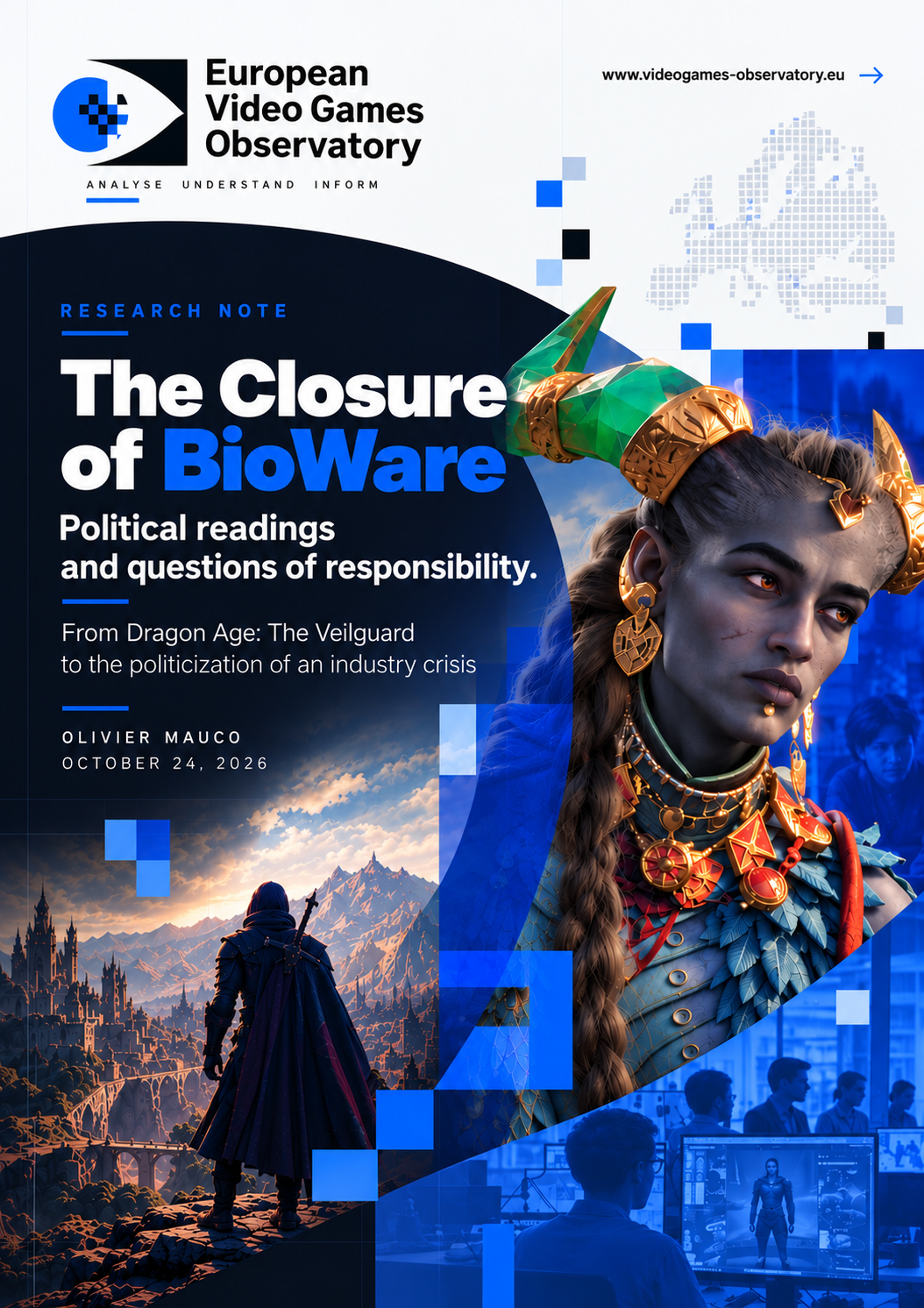
The official announcement, on October 21, 2026, of BioWare’s closure by Electronic Arts and the cessation of development on the next Mass Effect served as a major eye-opener. Beyond the shock to the history of Western role-playing games—from Baldur’s Gate to Dragon Age—the event immediately transcended the scope of a simple economic decision to become the stage for a political battle of interpretation on digital platforms.
At the European Video Game Observatory, we analyze these mechanisms: how is the public meaning of an industrial crisis constructed? Based on a corpus of 2,047 popular posts on X that accumulated over 141 million views, supplemented by a fine-grained analysis of the replies under the official press release and a semiotic examination of visual edits, our new research note highlights the drivers of this politicization.
A Reception Fragmented into Four Explanatory Regimes
Contrary to the illusion of a binary and homogeneous “culture war,” the reception of the announcement reveals the coexistence of four distinct responsibility attribution frameworks:
- Heritage Nostalgia: A tribute to a major creative legacy, bitterness over the loss of Edmonton’s expertise, and concern regarding the future of foundational franchises such as Mass Effect.
- Economic and Organizational Critique: The questioning of Electronic Arts’ financial logic, short-term profitability goals, and portfolio management decisions.
- Creative and Commercial Judgment: The internal analysis of successive setbacks (Anthem, Mass Effect: Andromeda, Dragon Age: The Veilguard), attributed to weaknesses in writing, game design, or project management without direct ideological reference.
- Ideological and Moral Imputation: The assertion that the so-called “woke” shift and inclusivity policies alienated the studio from its fans and led to its demise. Summarized by the slogan “Go woke, go broke,” this narrative sparks vigorous counter-arguments pointing to the long-standing integration of diversity themes in BioWare’s oeuvre.
The Overrepresentation of Controversy in the Reply Space
Quantitative analysis confirms a dynamic already documented in our prior research: the minority status of controversy relative to the sheer scale of its echo.
While explicit societal markers account for only 8.9% of the overall textual corpus, these posts capture 16.3% of recorded replies. This discrepancy highlights how engagement algorithms and conflict-driven dynamics reward controversy. Direct interaction spaces—such as the comments under BioWare’s farewell tweet—thus become public courtrooms where the corporation is summoned to account for its actions.
Images as Short-Circuited Causal Operators
Analyzing text alone is insufficient to understand the mechanics of politicization: short-circuited causal reasoning is most effectively constructed visually. Actors in the controversy deploy four main semiotic operations:
- Juxtaposition: Comparing archival photographs (e.g., the development team of KOTOR contrasted with that of The Veilguard) to visually imply decline without formulating a verifiable argument.
- Extraction: Isolating a specific video clip—such as Taash’s dialogue regarding non-binary identity—to present it as the sole symptom of the game’s direction.
- Appropriation: Repurposing past corporate communications campaigns (such as “Girls Behind Games”) to mock them in light of the ultimate commercial failure.
- Memification: Condensing a complex political narrative into visual archetypes that are instantly legible within partisan communities.
The industrial event no longer prompts inquiry; rather, it is retroactively co-opted as a confirming event. A publisher’s management decision is thus retroactively recast as a cultural verdict.
Key Takeaways for the Video Game Ecosystem
This textbook case underscores several critical strategic realities for studios and publishers:
- Porosity Between Corporate Identity and Product: In times of crisis, a company’s institutional history (HR statements, DE&I policies) and its game content merge within the public’s interpretive framework.
- The Trap of Surface Metrics: Relying solely on view counts or reply hostility leads to confusing online activist noise with the broader market.
- The Need for Circulation Analysis: Anticipating contemporary controversies requires moving beyond raw lexical monitoring to understand how game fragments become discursive resources in public debate.
Renseignez votre e-mail pour télécharger l'étude :